
Hosting UNSR Privacy/Free Speech 2025 on Warrantless Access to Subscriber Data seminar
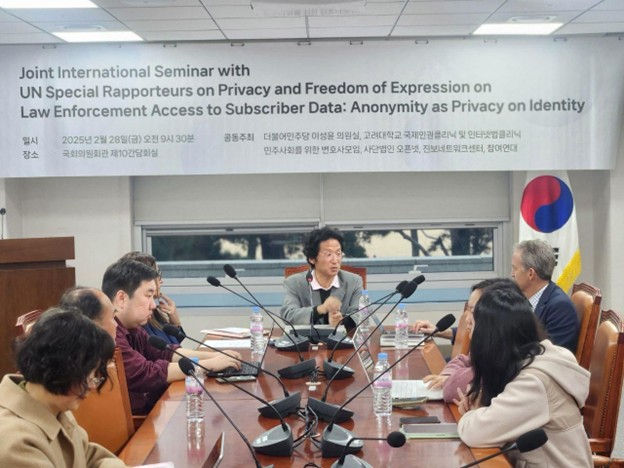
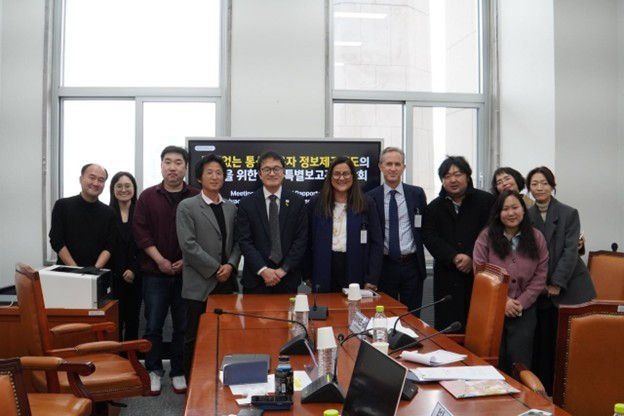
The Clinic, jointly with OpenNet, Lawyers for a Democratic Society, Jinbonet, People’s Solidarity for Participative Democracy, and the office of Democratic Party Rep. Lee Seong-yun jointly hosted an international seminar on February 28th, 2025. UN current and former human rights special rapporteurs were invited to discuss issues with communications user information provision in Korea.
In this seminar, under the moderation of Park Kyung-sin, director of OpenNet (and professor at Korea University Law School), UN Privacy Special Rapporteur Ana Brian Nougrères and David Kaye, a UC Irvine professor and former Special Rapporteur on Freedom of Expression, discussed the problems and improvement measures of the communication user information provision under the Telecommunications Business Act from the perspective of international human rights standards.
Special Rapporteur Ana Brian stated that "The ability to communicate without unnecessary scrutiny is essential to open societies, and its restriction can lead to significant human rights violations." She warned that "metadata is often underestimated in its potential impact, but when analyzed in bulk, it allows for the inference of personal habits, political opinions, and even private relationships." She also proposed legislative reforms including applying warrant principles, strengthening transparency in government information requests, and reinforcing strict standards and penalties for violations.
Former Special Rapporteur David Kaye emphasized that "the freedom of anonymous communication is a core right for guaranteeing freedom of expression protected by international human rights norms." He further noted that "if the UN Cybercrime Convention takes effect, it could further justify and deepen state surveillance and information sharing through mutual monitoring. Therefore, it is important for South Korea not to ratify the UN Cybercrime Convention. Cybercrime can be properly addressed through ratification of the Budapest Convention, which has procedural safeguards for surveillance."
David Kaye submitted an opinion to the Constitutional Court in 2017, arguing that the communication user information provision system restricts freedom of anonymous communication and violates privacy. In this case, the Constitutional Court made a decision of constitutional non-conformity for the communication data provision system (currently the communication user information provision system), and in 2023, the National Assembly mandated post-notification through legal amendments. However, both Ana Brian and David Kaye judged that the current law does not meet warrant principle requirements. Joseph Kanatacci, the former Privacy Special Rapporteur who officially visited in 2019, also expressed concerns about the communication user information provision system and strongly emphasized that court approval is absolutely necessary when providing information.
Following the seminar, Special Rapporteurs Ana Brian and David Kaye attended a roundtable discussion at the National Assembly on "Improving the Communication User Information Provision System," hosted by National Assembly Health and Welfare Committee Chair Park Ju-min. The event was also attended by experts including Science, Technology, and Broadcasting Committee member Rep. Hwang Jung-ah, Professor Park Kyung-sin, and Jinbonet Representative Oh Byung-il.
Ana Brian stated that "Under current Korean law, freedom of expression is suppressed, and basic rights cannot be guaranteed in the digital age," and proposed "revising the Telecommunications Business Act, which allows investigative agencies to indiscriminately collect personal information, to achieve institutional improvements that align with international human rights norms."
David Kaye emphasized that "To ensure the vocalization of vulnerable groups' perspectives and free media activity, freedom of expression must be substantially guaranteed through protecting the freedom of anonymous communication." He also urged "Korea to actively review ratifying the Budapest Convention from a forward-looking perspective.