
Litigation 2021-2: COVID and Military Coup stall trial too much for courts to wait to hear testimonies of abuse
최종 수정일: 4월 23일
After the powers of attorney were certified in February 2019, the plaintiffs tried to prove the case (i.e., coerced land transfer) relying on the testimony of the former local government officials who oversaw the transfer. However, COVID19, begun spreading in January 2020, caused the border shutdown which made it impossible to bring the witnesses to trial, and then in February 2021, the military coup took place, again prolonging the border shutdown beyond the COVID period. Although the plaintiffs pleaded withe the court for allowing more time or video testimony, the courts accepted neither. The details are below:
In July 2021, the first-level court dismissed the lawsuit, citing lack of jurisdiction. The court reasoned that the land transfer was more like confiscation by the government entity MOGE and also that most of the evidence on the nature of the land transfer are in Myanmar, and therefore that the South Korean court lacks jurisdiction (judgment attached below).
The court sitting in the domicile of a defendant, by principle, has jurisdiction over the the defendant as demonstrated in the paper published by the Clinic's students Jongyeon CHOI and Miro Kang with another author Soojin KONG (attached below).
The Clinic also held a seminar November 2021 where a former judge of more than 20 years experience who was also currently teaching civil procedure at a major law school confirmed the above principle for this case as well (his notes attached here).
The court questioned the availability of sufficient witnesses for proper adjudication, citing the time and difficulty that the plaintiff was having collecting the evidence such as the reasonable market value of the land. Again, it was COVID19 and the military coup that made it practically impossible for the plaintiff either to travel to Myanmar for fact-finding or bring witnesses to testimony in Seoul.
Also, under Myanmar law, the land records were not public records and were given only to the owners upon their request, the defendant DAEWOO/POSCO refused to provide the land records, making it impossible for the plaintiffs to even show the exact location and size of the land taken.
The Clinic did obtain the internal report on DAEWOO's acquisition activities (attached below) showing the formulas for calculating the amount of compensation and the general method of acquisition. However, the exact values in using the formulas such as the basic land values per square footage or the weigh factors were coded (i.e., "X"), making it impossible to evaluate the propriety of compensation.
Plaintiffs appealed and the appellate court issued the judgment in August 2022 one year later. The appellate court did recognize the jurisdiction but again found that the defendant DAEWOO/POSCO was acting "on behalf of MOGE" and therefore is not responsible for the land transfer, and that sufficient evidence of coercion was not presented by plaintiffs.
Again, the plaintiffs pleaded withe the court for allowing more time or video for witnesses to testify, the appellate court accepted neither option. Also, the fact that DAEWOO/POSCO was acting "on behalf of MOGE" under some other contract that plaintiffs were not privy to does not absolve the defendant DAEWOO/POSCO of its responsibility as a direct party to the land transaction. The appellate court did not accept this legal argument.
There were sufficient reports of abuse in the land acquisition process as reported by reputable NGOs in the region such as Shwe Gas Movement and Earth Rights International.
Also, the 2016 report by Myanmar Pipeline Watch Committee detailed the land acquisition process done by the Chinese company building pipelines who used the same contract forms and the same methodology as DAEWOO and demonstrated the coercive and uninformed nature of the transfer (attached below followed by representative excerpts).

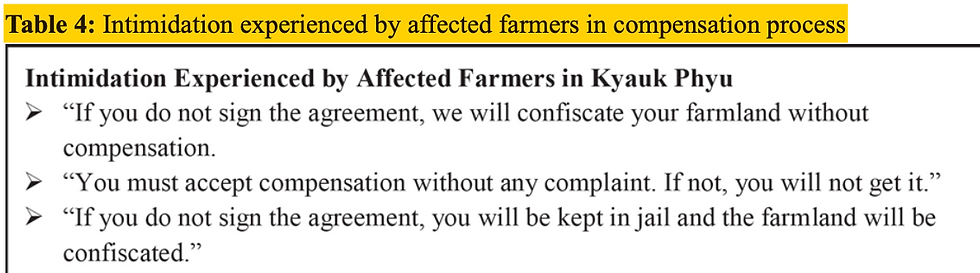
While maintaining the suit, the Clinic noticed the irony that the lawsuit faced: the money made by DAEWOO/POSCO from the Shwe gas and then funneled to MOGE financed the military coup which in turn shut down the border and made impossible the plaintiffs' testimony against DAEWOO/POSCO, shutting down the trial. The Clinic shifted gear in strategy to: exposing DAEWOO/POSCO's role in sustaining the military rule, which was the original reason that the Clinic began the litigation project for Kyaukphyu farmers.