
Hebei Spirits Oil Spill litigation support 2008-2015
최종 수정일: 5월 15일
[Excerpts from Suvro Sarker, Ed., Clinical Legal Education in Asia, Palgrave Macmillan (2015)] In December 2007, a barge owned by Samsung Heavy Industries and loaded with a crane
collided with a foreign-registered supertanker, the Hebei Spirit, spilling 10,500 to 11,000 tons of
oil (a quarter to a third of the infamous 1989 Exxon Valdez spill in the United States) on the 120
miles of scenic seashores of Taean, about 90 miles southwest of Seoul.29 The spill devastated
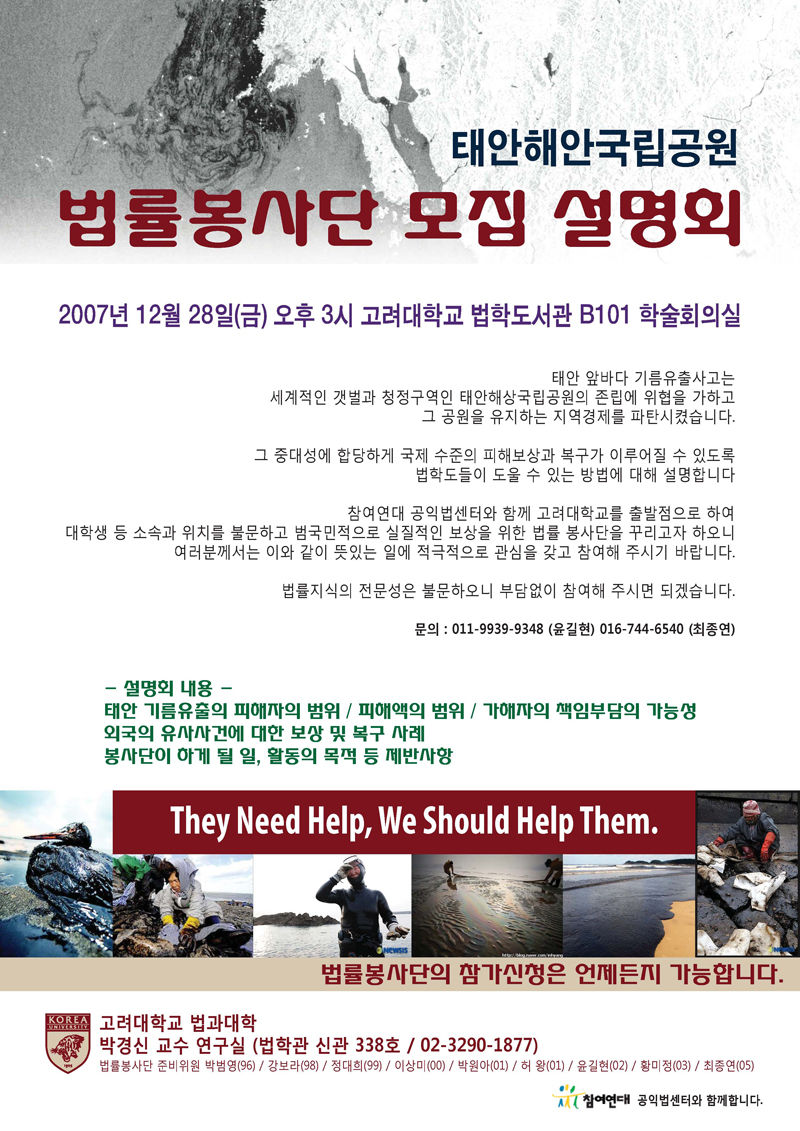
tourism, fisheries, oyster beds, and the residents’ lives.30 In the wake of the spill, over 280students, mostly from colleges of law in Seoul, participated in coordinated legal advocacy for the
local residents affected by the spill under the supervision of Korea University law professor
Kyung Sin Park (coauthor of this chapter), Hyun Woo Nam (a local attorney), and several other
volunteer lawyers.31
From early on, the damages caused by the spill so close to and broadly affecting the vast
Taean Seashore National Park 32 were initially estimated to be close to 1 trillion KRW
(approximately $980 million USD), easily exceeding the aggregate compensation limit of about
321.6 billion KRW set by the relevant international conventions and local legislations enforcing
them.33 Especially disturbing was the initially prevailing media report that the total liability of
Samsung Heavy Industries, the primary tortfeasor, whose sea crane approached and collided with
the oil tanker Hebei Spirit, which was at a standstill at the time, after more than a full hour of
advance warning of such collision, would be statutorily limited to 5.6 billion KRW. That is, in
their news coverage, the mainstream media, dependent on Samsung business groups’ advertising,
often reported that there was a statutory cap on damages and strongly discounted the possibility
that such a cap may be inapplicable where the ship owner commits a tort knowingly and
recklessly.
Because the total compensation amount was perceived to be capped (aggregating the
Heibei Spirit’s insurance proceeds and the International Oil Pollution Compensation [IOPC]
Fund covering Samsung Heavy Industries’ liabilities, the latter of which are set so that the total
amount came to 321.6 billion KRW), local residents did not expect full compensation, and thus
in some cases were hesitant to seek relief. If the damages were indeed capped, then larger
compensation awards to some victims would have meant a smaller recovery for other victims.
The groups that suffered economic damages especially were discouraged about pursuing claims
because recovery of such damages was again publicized, and therefore perceived, as difficult under the IOPC Fund’s rules, which governed the payout scheme for both sources of
compensation.
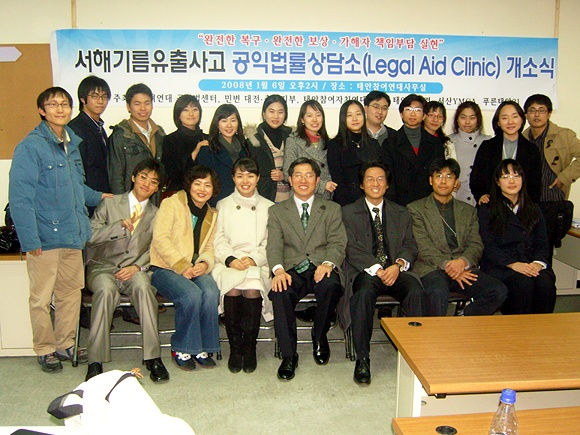
The joint Volunteer Corps of professors, lawyers, and students34 set up an on-site legal
clinic for two months,35 mostly assisting those suffering economic damages in the preparation of
applications for compensation. One of the victims of the oil spill was the owner of an ocean view
villa. Expecting and actually receiving no guests after the oil spill, he rented the facility to the
Volunteer Corps for free during the two months, which the members made judicious and
pleasant use of as they came from Seoul in groups of four or five and stayed there for a week at a
time. The Volunteer Corps published and distributed biweekly newsletters, which delivered the
information about liability and compensation that the mainstream media did not cover, such as
the possibility that damages might not be capped. The Volunteer Corps also conducted a relay
demonstration for several weeks in front of Samsung’s headquarters, 36 urging the global
company not to hide behind the treaty-based liability limitation and to offer a fair compensation
proposal. 37 The Volunteer Corps members summarized their counseling experience by
publishing a manuscript titled “200 Questions and Answers on Oil Pollution Compensation,”38
which was mass produced and locally distributed to the broader communities affected by the oil
spill. The Corps members also collected and translated into Korean, major overseas precedents
interpreting the liability limitation regimes for sea and air carriers, in order to encourage and
educate lawyers who might have wanted to eliminate the damages cap by proving that Samsung
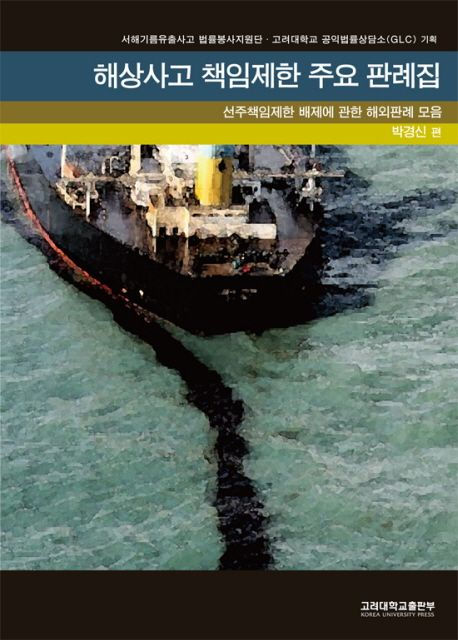
had been reckless. This collection was officially published many months later in July 2009, as a
529-page volume, Major Cases on Ship Owner’s Liability Limitation, and included Professor
Park’s preface analyzing the significance of these precedents.39
The Volunteer Corps was successful in turning the public’s attention to the possibility of
“unlimited liability,” a term first used by the Corps, which then gained wide acceptance among
the general public as a normative standard to be applied. Moreover, group of law firms came
forth to represent economic damages victims on a pro bono basis, taking on the task of
attempting to prove Samsung’s recklessness in an effort to eliminate the liability cap. After five
months of operation, the Volunteer Corps dissolved itself and turned over all the intake
documents to a public interest litigation group, including the law firms providing pro bono
assistance. Litigation against Samsung on the limitation cap issue lasted for more than four years,
until the Supreme Court’s decision on April 17, 2012 that did not eliminate the cap.40
What was significant for clinical education was that the Volunteer Corps’ efforts became
widely known in college circles and raised the awareness of such education among officials at
Korea University, who were at the time planning for the opening of a three-year law school in
2009. They commissioned Professor Park to create a pilot project with undergraduate law
students in June 2008. The newly created Global Legal Clinic was the first attempt at clinical
education in Korea, and it was to be later transplanted once Korea University established a new
law school under the new system.
The pilot Global Legal Clinic soon grew from 10 to more than 20 students who worked at
three clinics: the Oil Spill Compensation, Foreign Workers’ Rights, and Blind’s Web
Accessibility Clinics, all of which had very narrowly tailored goals. The Oil Spill Compensation
Clinic was to be a policy clinic, the goal of which was lobbying the government to ratify the
protocols governing the IOPC Supplementary Fund. Korea’s ratification would result in
increasing the amount available for compensation, from about 360 billion KRW to about 1
trillion KRW. The Foreign Workers’ Rights Clinic was also to be a “policy clinic,” the goal of which was to repeal the law requiring public employees to report any undocumented alien to the
immigration authorities, most of the time, for deportation. The Web Accessibility Clinic was to
be a “litigation clinic” aimed at filing civil rights suits against companies and agencies for failing
to configure their websites for accessibility to the blind.
When the new law school opened at Korea University in March 2009, the Global Legal
Clinic became the country’s first clinical center that offered a course that could be taken for
academic credit at a law school, and in 2010 it changed its name to the Clinical Legal Education
Center (CLEC). The three earlier pilot clinics continued to be offered to law school students and
resulted in tangible achievements in 2010 and 2013, which are discussed below.
Also, several college law students who participated and played leadership roles in the
Volunteer Corps and the Global Legal Clinic enrolled in the new law schools in 2009 or 2010
and became active in or otherwise contributed to the formal clinics established there.41 The
student leadership was very important for the early phases of the law school clinics because there
was barely a professor with any clinical education experience either as a student or as a professor. . . . CLEC’s major victories include the country’s ratification of the protocols leading to
Korea’s enrollment in the International Oil Pollution Compensation’s Supplementary Fund
(April 2010)73 and the settlement of the web accessibility lawsuit of the blind against Korean Air
Line (October 2013),74 both of which originated from the work of the pilot projects begun in
2008. With those achievements, the Oil Spill Clinic and the Blinds’ Web Accessibility Clinic
closed. 29 John M. Glionna, “South Korean Oil Spill Victims Cautionary Tale” Los Angeles Times (July
17, 2010); Sang-Hun Choe, “South Korea Cleans Up Big Oil Spill” The New York Times (New
York, December 9, 2007).
30 Ibid.
31 West Seashore Oil Spill Accident Legal Services Volunteer Corps
(Seohaeangireumyuchulsagobeobryulbongsajiwondan),
http://club.cyworld.com/taeanlegalservice, accessed June 12, 2014. The number of student
volunteers can be found at this social media site used by the volunteers.
32 Official website of Taeanhaean Korea National Park Service, National Parks of Korea,
Taeanhaean,
accessed June 16, 2014.
33 Facts about the case are known to coauthor Park from his work on the case.
34 Beobryul Journal, “Full Restoration, Full Compensation, No Liability Limitation on
Wrongdoers”(seohaegireumyuchulsagoui “wanjeonbokgu.wanjeonbosang,
gahaejamuhanchaegim) January 7, 2008
http://news.lec.co.kr/gnuboard4/bbs/board.php?bo_table=pass&wr_id=36158>, accessed June 12,
2014. The social media site through which the volunteers communicated was opened at
<http://club.cyworld.com/taeanlegalservice, accessed June 12, 2014.
35 Yonhap News, “On-site Legal Clinic Opens for Oil Spill Victims(chamyeoyeondae,
taeanheonjibeobryulsangdamsogaesomitbongyeokjeoginbeobryuljiwonhwaldongsijak)” (Seoul,
January 7, 2008)http://app.yonhapnews.co.kr/YNA/Basic/article/Press/YIBW_showPress.aspx?contents_id=RPR20080107025200353, accessed June 12, 2014.
37 Mainly due to similar protests from the victims, Samsung agreed in November 2013 to make a
regional development grant of about 360 million USD to be distributed over the affected region.
For related news report, see below.
L, accessed June 12, 2014. The individual victims cannot receive cash under this arrangement.
L, accessed June 12, 2014.
38 Text of the questionnaire available at
June 12, 2014.
39 The book is being commercially sold.
9788976416957&orderClick=LAG&Kc=, accessed June 12, 2014.
40 Supreme Court Judgment 2010 ma 222. The Supreme Court unfortunately did not find the
requisite recklessness and knowledge of probable damage on the part of Samsung. It was
interesting that the Supreme Court used the complete lack of any direction from the land crew as
evidence negating the ship owner’s “personal knowledge,” but did not choose to allow the same
to be the basis for attributing the captain’s conduct to the shipowner under the theory of blanket
entrustment. 41 Just to name a few, Mi Ro Kang and Ik-Chan Sohn went on to Seoul National University and
led in the creation of and participated in a newly created workers’ compensation clinic there,
which delved into the leukemia cases that Samsung Semiconductors refused to recognize as
work related. Ji-Heon Oh and Woo-Koo Choi went to the graduate law program of their alma
mater, Korea University, and continued on with their respective clinical tasks to remarkable
success, i.e., the IOPC Supplementary Fund advocacy and publication of the translation of Major
Cases on Ship Owner’s Liability Limitation. Jong Yeon Choi and Kelly Kha-Yeun Kim joined in
the first field trip to the Burma-Thai border in February 2010 in an effort that was later
formalized into the International Human Rights Clinic of Korea University Law School. Choi
also coauthored the first published paper on the feasibility of a Doe v. Unocal-type remedy for
Daewoo International, which provided a blue print for the subsequent actions of Korea
University’s International Human Rights Clinic. Jong Yeon Choi, Mi Ro Kang, and Soo Jin
Kong, “A Forlorn Garden—Human Rights Abuse in Shwe Gas Development and Feasibility of
Legal Action in Korea” (2010) 8 Gong-ik-gwa In-gwon 4,
http://www.papersearch.net/view/detail.asp?detail_key=2y800094, accessed June 12, 2014. Kim,
who led the Global Legal Clinic as a student, also coauthored the first published paper on the
issue of web accessibility for the blind, which was submitted to court in a lawsuit against Korean
Airline in 2011. Kyung Sin Park, Kelly Kha-yeun Kim, Seong-hun Kim, Son-hee Yang, and Pil-
kyu Chae,“The Blind’s Web Accessibility: A Comparative-Legal Analysis with a Focus on the
U.S., the U.K., and Australia” (2011) 61 GoryeoBeobhak 131,
www.papersearch.net/view/detail.asp?detail_key=1f501080, accessed June 12, 2014. . . . 73 Ministry of Land, Transportation, and Seas, Ocean Policy Division, “Ocean Oil Pollution
Compensation Limit Increased to 1.2 Trillion Won—Due to Korea Joining the IOPC
Supplementary Fund” Bloghttp://blog.naver.com/PostView.nhn?blogId=mltm_ocean&logNo=60106721950&viewDate=&c
urrentPage=1&listtype=0, accessed June 12, 2014.
74 PSPD Homepage, “Korean Airline Settles on Blind’s Web Accessibility—Due to Fix by May
31, 2014” (October 12, 2013) http://www.peoplepower21.org/PublicLaw/1079578, accessed
June 12, 2014.